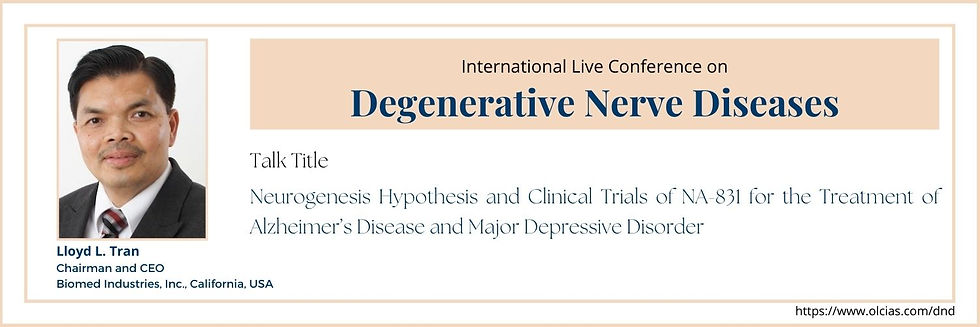
Neurogenesis Hypothesis and Clinical Trials of NA-831 for the Treatment of Alzheimer’s Disease and..

Updated: Oct 7, 2023
Talk Title: Neurogenesis Hypothesis and Clinical Trials of NA-831 for the Treatment of Alzheimer’s Disease and Major Depressive Disorder

Author: Dr. Lloyd Tran Chairman & CEO Biomed Industries, Inc. San Jose, California USA Email: LTran@biomedind.com Volume: Degenerative Nerve Diseases 2023_CN43_AA01 International Live Conference on Degenerative Nerve Diseases Date: October 07, 2023 Time: 8 PM Indian Standard Time Location: Online Conference Theme: Navigating the Spectrum of Neurodegenerative Challenges: From Diagnosis to Novel Therapies
Abstract
Description The hippocampus continues to generate new neurons throughout life, a process is known as adult hippocampal neurogenesis (AHN). AHN impairment compromises hippocampal function in AD and MCI. This indicates that reduced AHN causes memory impairments and cognitive deterioration in the disease. In addition, AHN is crucial for the regulation of mood. If disturbed, it can have severe consequences for mental health. AHN has been shown to be involved in Major Depressive Disorder (MDD) and Alzheimer’s disease pathology. The clinical trials of a new drug, NA-831 presented here provide some evidence that AHN is involved in both AD and MDD. Phase 2A Clinical Trials of NA-831 for the treatment of Alzheimer’s Disease NA-831 is a small drug molecule, easily crosses the blood brain barrier with excellent bioavailability. The drug exhibits neuroprotection, neurogenesis and memory enhancing properties. A randomized Phase 2A clinical trial of NA-831 was performed in 112 participants with mild and moderate Alzheimer’s disease, half received the drugs and half received placebo. The patients with MCI received 10 mg of NA-831 or placebo orally per day. The patients with mild and moderate Alzheimer’s disease received 30 mg of NA-831 or placebo orally per day. Subjects with MCI to meet the NIA-AA core clinical criteria for mild cognitive impairment due to Alzheimer's disease. NA-831 showed a significant improvement for patients with mild and moderate AD with the ADAS-Cog-13 score change of an average of 4.1 as compared to the placebo after 24 weeks of treatment (p = 0.001; ITT). CIBIC-Plus showed 78 % patients improved (p = 0.01; ITT). mNA-831 was well-tolerated at 30 mg/day. There were no serious adverse events observed. Phase 1B Clinical Trials of NA-831 for Major Depressive Disorder (MDD) We completed a Phase 1B pilot study, which was a randomized, double-blind, fixed-dose, placebo-controlled, active reference study to investigate the efficacy, safety, and tolerability of two fixed doses (20 and 40 mg/d) of NA-831 vs. that of placebo after 6-week treatment in 32 adult patients with major depressive disorder (MDD). The most common adverse effects reported in the active NA-831 treatment groups were mild headache and dry mouth. Both doses of NA-831 resulted in a significant improvement compared to placebo on the primary efficacy analysis. The difference between active treatment and placebo of ∼7 points on the MADRS translates into a clinically relevant difference in response rates of 32.5 % units, compared to an average of 16% units for antidepressants approved by the USA and European health authorities. Treatment with NA-831 for 6-week was well tolerated and efficacious in reducing depressive and anxious symptoms in patients with MDD. Conclusion: The Neurogenesis Hypothesis has been shown to be a viable approach for further research for Alzheimer’s disease (AD) and Major Depressive Disorder (MDD). Biomed is in the process of conducting a Phase 2B and Phase 3 trials of NA-831 for the treatment of AD and MDD. Keywords: NA-831, Lloyd Tran, Alzheimer’s disease, Major Depressive Disorder, depression, neurogenesis, neurodegenerative diseases, Biomed Industries, Inc.
Biography: Lloyd L. Tran, PhD Chairman & CEO Biomed Industries, Inc. San Jose, California USA Lloyd is a scientist with 25-year experience in drug development and clinical trials management. He is an inventor with a number of patents in drug therapeutics in the treatment of neurological and infectious diseases. Lloyd serves as the chairman & CEO of Biomed Industries, Inc., the parent company of Biomed Pharmaceuticals, NeuroActiva, Biomed AI and MedAware Systems, Inc. Biomed is conducting phase 2B and phase 3 of NA-831 for the prevention and treatment of Alzheimer’s Disease. In his early career, he was employed as a research scientist at G.D. Searle, (a subsidiary of Pfizer), and was the director of R&D at Biomed Pharmaceuticals. Lloyd graduated with a BSc(Honours) and completed a PhD in medicinal chemistry at University of Otago and Wellington University of New Zealand.